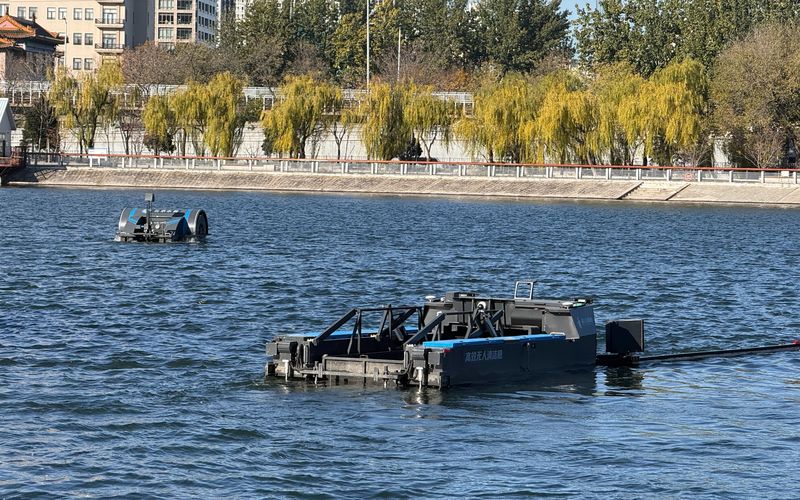
11月18日,北京市在朝阳区高碑店湖等8条重点河道规模化应用28艘智能无人船,进行水面保洁和割草作业 1。这批被称为“河面扫地机器人”的设备包含10艘清洁船和18艘割草船,通过预先设置路线自主作业,并由岸上安全员监控,综合作业效率较传统人工提升2.5倍以上 1。强降雨过后,过去人工需约24小时完成的水面清理工作,无人船配合人工可缩短至8-10小时 1。
截至2026年10月,28艘无人船累计运行1500小时,航行3580公里,作业面积超过1000万平方米 1。无人船规模化应用后,每日可减少作业人员44人,年度减少作业人员1.4万人次,维护资金节约100余万元 1。北京已建成国内首个无人船智慧运维平台,连接管理单位、运维单位和一线作业人员,实现了从试点到成网连片的转变 1。下一步将探索向潮白河、北运河、凉水河等河道推广,并考虑搭载水质监测等设备 1。
On November 18, 2026, Beijing officially launched the large-scale application of 28 intelligent unmanned boats for surface cleaning and grass-cutting operations on eight key waterways, including Gaobeidian Lake in Chaoyang District 1. These vessels, referred to as “river surface sweeping robots,” consist of 10 cleaning boats and 18 grass-cutting boats, achieving a comprehensive operational efficiency more than 2.5 times higher than traditional manual methods 1. The unmanned boats execute tasks autonomously along pre-set routes under the real-time monitoring of safety officers on shore, marking Beijing's transition from pilot programs to a networked, interconnected phase of smart maintenance 1.
By October 2026, these unmanned boats had accumulated 1,500 hours of operation, traveled a total distance of 3,580 kilometers, and covered a working area exceeding 10 million square meters 1. In response to post-heavy-rainfall surface cleanup needs, tasks that previously required approximately 24 hours of manual labor can now be completed within 8 to 10 hours using a combination of unmanned boats and human effort 1. Following this scaled deployment, daily staffing requirements have decreased by 44 personnel, with an estimated annual reduction of 14,000 person-days in labor and savings of over 1 million yuan in maintenance costs 1.
Beijing has established China's first smart operations and maintenance platform for unmanned boats, effectively linking management units, maintenance providers, and frontline workers 1. Looking ahead, the city plans to expand this model to other waterways such as the Chaobai River, North Canal, and Liangshui River, while exploring the integration of equipment like water quality monitors to extend the functional capabilities of the unmanned fleet 1.
评论
还没有评论,欢迎留下第一条。