中国物联网产业发展正在经历关键转折。2025年底,物联网设备连接数首次超过人类连接数,占比达61.3%,标志着产业进入新阶段1。工信部等部门随之制定了更为宏大的目标——2028年物联网核心产业规模突破3.5万亿元1。
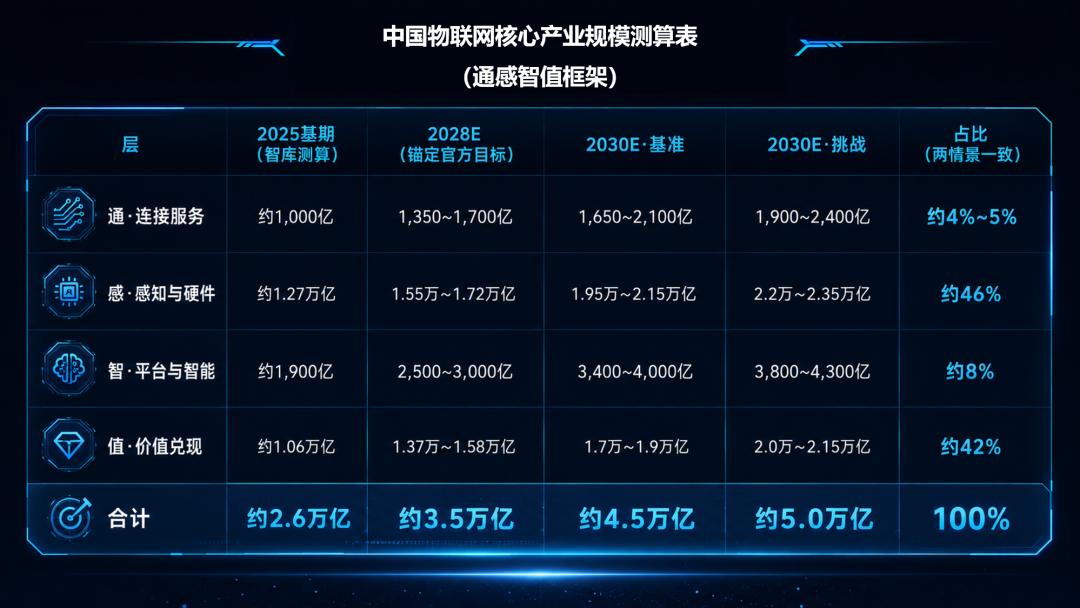
从规模拆解看,这一目标的内部结构已渐趋明晰。基于"通感智值"四层框架,硬件设备("感"层)约占46%,是当前最大的单层支撑1;价值兑现("值"层)约占42%,成为最大的增量方向1。从基期来看,2025年中国物联网核心产业规模约2.6万亿元,要达成3.5万亿目标隐含年复合增速约10%1。同时,"六张网"年度投资超7万亿元,按1%-3%比例可转化为700亿-2000亿元的物联网直接需求1,为产业增长提供了潜在动能。
物联网的底层逻辑正在发生反向迁徙——智能正从云端向物理世界逐步转移1。到2028年,工业互联网平台将超过450家,连接工业设备突破1.2亿台1,映射出AIoT 3.0时代的到来。
China's internet of things (IoT) sector has reached a critical inflection point, with connected devices now outnumbering human connections for the first time. As of the end of 2025, devices account for 61.3% of total IoT connections, surpassing the 60% threshold and marking a transition from the second to third phase of IoT development 1. This milestone reflects a fundamental shift in how the technology landscape is evolving, with intelligence increasingly migrating from cloud infrastructure back toward the physical world in what analysts are calling the AIoT 3.0 era 1.
The scale of opportunity is substantial. China's Ministry of Industry and Information Technology and other government departments have set an ambitious target of breaking through 3.5 trillion yuan in core IoT industry revenue by 2028 1. Based on 2025's estimated 2.6 trillion yuan foundation, this goal implies an annual compound growth rate of approximately 10% 1. The industry's value chain can be understood through a four-layer framework: connectivity infrastructure representing 4–5% of value, hardware sensors at 46%, intelligence and algorithms at 8%, and value realization services at 42% 1. Hardware currently dominates as the single largest component, while value realization services represent the most significant growth opportunity 1.
Underpinning this expansion is massive infrastructure investment. The nation's "six networks" receive annual investment exceeding 7 trillion yuan, which could translate into 7 billion to 20 billion yuan in direct IoT demand annually based on a 1–3% conversion ratio 1. Looking ahead to 2028, the industrial IoT ecosystem is expected to mature significantly, with over 450 industrial IoT platforms operating and connected industrial devices reaching 1.2 billion units 1.
评论
还没有评论,欢迎留下第一条。