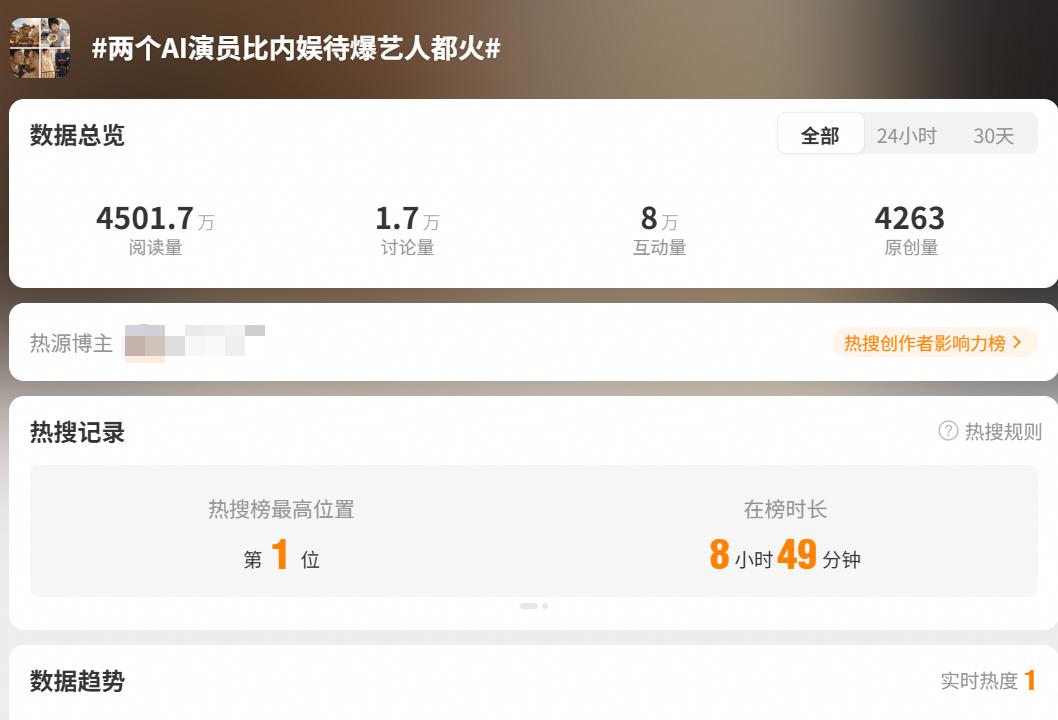
AI短剧《被裁掉的女孩》中的虚拟角色方桃子凭借超2亿次播放量和38.7万粉丝量走红网络1,与另一AI角色周以衡(粉丝量12.8万)合计粉丝突破50万1,在社交平台建立了完整的粉丝互动生态。这一现象引发广泛关注,相关话题"两个AI演员比内娱待爆艺人都火"曾冲上热搜榜首,霸榜超8小时,阅读量超过4500万1。
AI影视产业的这一突破反映了更广泛的行业变化。2025年国内AI生成视频、音频累计超20亿条,较2024年增长14倍以上1;2026年一季度全行业上线微短剧约12.8万部,其中AI短剧占比超95%1。与此同时,AI剧集也开始登陆电视荧屏,安徽卫视已播出AI剧《桃花潭记》(共20集、每集约10分钟),成为国内率先播出AI剧集的上星卫视之一1。爱奇艺推出"AI艺人库"计划,已有超100位深度合作艺人同意入驻1。
这一变化标志着AI从后期工具向前端内容生产的升级1,但同时也引发了关于演员肖像权和职业替代的争议1。国家广播电视总局于7月1日起施行《管理提示(AI微短剧分类分层标准)》1,反映出监管部门对这一新兴领域的规范态度。
Virtual characters from the AI-generated short drama "The Girl Who Got Laid Off" have become unexpected celebrities, with the character Fang Taozi accumulating over 200 million views and 387,000 followers, while her co-star Zhou Yiheng has attracted 128,000 followers across their independent social media accounts 1. The combined fanbase of both characters has exceeded 500,000 followers 1. The phenomenon generated such significant online attention that the topic "two AI actors more popular than up-and-coming entertainment industry stars" topped trending lists for over eight hours, with the discussion garnering more than 45 million views 1.
The rise of these virtual characters marks a significant shift in AI's role within the entertainment industry, moving from post-production tools to front-end content creation 1. AI-generated short dramas have begun airing on traditional television, with Anhui Satellite TV broadcasting the AI drama series "Taohuatan Chronicles," comprising 20 episodes of approximately 10 minutes each, making it among the first mainstream provincial television stations to air AI-produced content 1. Industry data shows that in the first quarter of 2026, approximately 128,000 short dramas were released across the sector, with AI-produced content accounting for over 95 percent 1. Additionally, iQiyi launched an "AI Artist Library" initiative with over 100 artists agreeing to participate 1.
However, the emergence of AI virtual stars has raised concerns about performer likeness rights and potential job displacement in the entertainment sector 1. In response to these developments, China's National Radio and Television Administration implemented management guidelines on July 1st regarding classification and tiered standards for AI-generated short dramas 1.
评论
还没有评论,欢迎留下第一条。