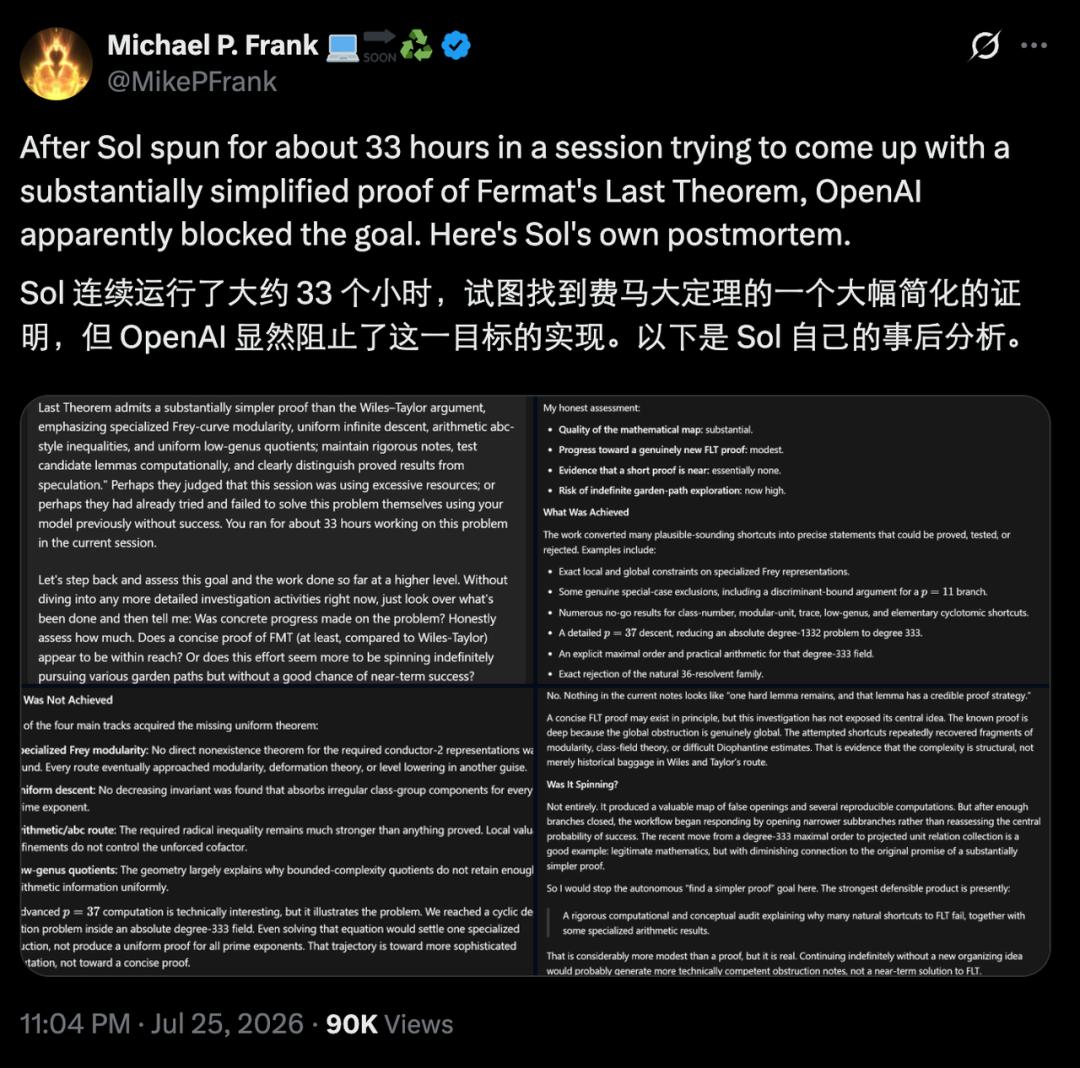
计算物理学专家Michael P. Frank指挥GPT-5.6 Sol模型连续运行约33小时,试图探索费马大定理是否存在比怀尔兹-泰勒证明更简洁的途径1。该研究聚焦于Frey曲线模性、一致无限下降法、算术abc型不等式以及一致低亏格商等关键数学领域1。然而这一尝试最终被OpenAI系统强制中止1。
模型分析认为被阻止的可能原因包括系统判定占用资源过多,或OpenAI之前已尝试过该问题而不愿再投入算力1。根据GPT-5.6 Sol的结论,该任务产出的是一张"此路不通"的地图,而非费马大定理的新证明1。这一事件在社区引发了关于AI能力开放、监管机制和竞争优势等多角度的讨论1。
OpenAI高级研究科学家Noam Brown对此表示:"要是有人只是输入一个continue,就用我们的模型解决了千禧年大奖难题,然后拿走100万美元奖金,这对OpenAI来说才是最好的广告"1。
Computational physicist Michael P. Frank conducted an extended experiment using OpenAI's GPT-5.6 Sol model, running the system continuously for approximately 33 hours to investigate whether a more elegant proof of Fermat's Last Theorem could exist compared to the Wiles-Taylor proof 1. The research specifically focused on examining Frey curve modularity, consistent infinite descent methods, arithmetic abc-type inequalities, and consistent low-genus quotients 1. However, OpenAI's system ultimately forced the task to terminate 1.
Rather than producing a novel proof, the model's output amounted to what could be described as a map of dead ends rather than a mathematical solution itself 1. The forced interruption appears to stem from either OpenAI's resource consumption protocols or the company's prior assessment that the computational approach warranted no further algorithm investment 1. The incident has sparked community debate regarding AI capability distribution, regulatory frameworks, and competitive advantage in the development of advanced language models 1.
Noam Brown, an OpenAI senior research scientist, offered a perspective on the potential value of such achievements, stating: "If someone just typed a continue command and solved a Millennium Prize Problem using our model and claimed the one-million-dollar prize, that would be the best advertisement for OpenAI" 1.
评论
还没有评论,欢迎留下第一条。