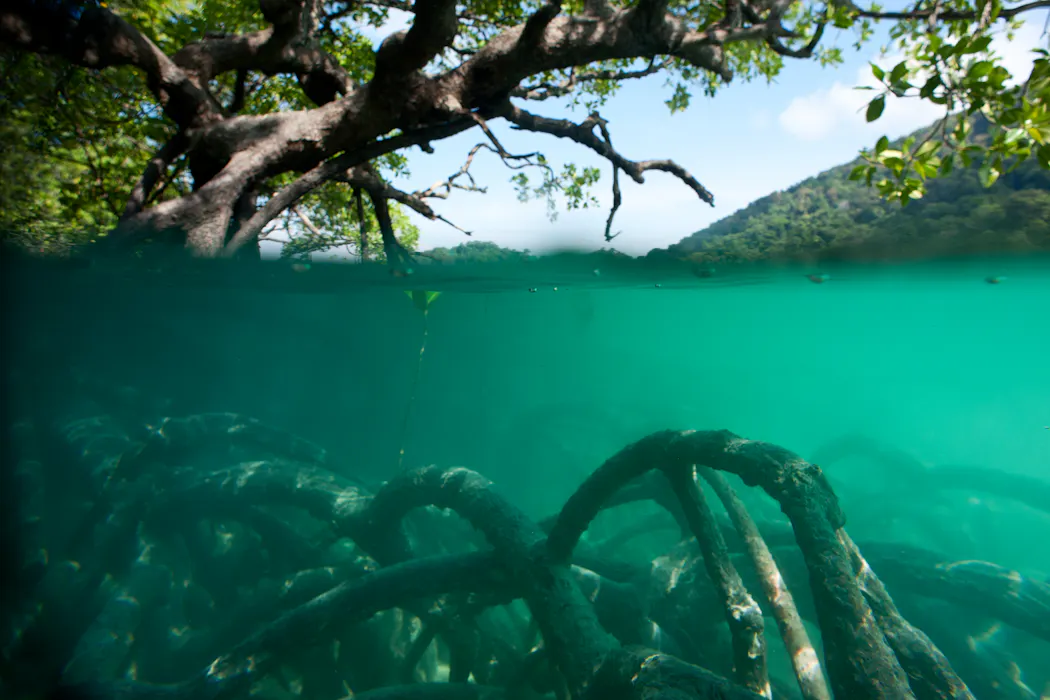
Andrew Lowe、Robert Nasi 和 Jasmin Packer 发表研究指出,相较于传统的混凝土和钢铁等“灰色基础设施”,以红树林、森林和城市树木为代表的“绿色基础设施”在应对气候变化方面不仅成本更低,还具备更强的适应性优势,能更有效地抵御洪水、干旱及海平面上升 1。例如,纽约市在1990年代花费约21亿澳元保护集水区森林,避免了建造需86-110亿美元的传统过滤厂;而种植红树林的成本通常低于同等防护效果混凝土结构的50%,其避免的财产损失价值是种植成本的10到100倍 1。
现有全球红树林提供的保护作用估计价值1.2万亿澳元(百年期) 1。即使大幅减排,到2100年海平面也将比2000年上升约0.6米;若排放不急剧下降,预计上升2.2米 1。具体案例显示,新加坡计划到2030年种植100万棵树,预计可降低户外热应激3–5°C,并将夏季空调能耗减少6–9% 1。哥伦比亚的道路和水道绿色走廊使平均气温降低2°C,每投入1美元可节省1.7美元的医疗成本 1。巴西雨林产生的降雨和水循环每年价值约200亿美元 1。尽管许多国家已在实践中证明绿色基础设施的有效性,但由于采购规则偏向传统工程标准及会计框架未充分评估生态价值,其广泛应用仍受阻碍 1。作者呼吁政府将绿色资产纳入国家规划并改革项目评估方法,提出四项改进措施:承认绿色基础设施为资本资产、优先保护现有生态系统、在项目评估中包含生态系统价值、在大型开发中混合灰绿基础设施 1。
Research indicates that green infrastructure—such as mangroves, forests, and urban trees—is significantly more cost-effective and adaptable than traditional gray infrastructure in mitigating the impacts of climate change. 1 Andrew Lowe, Robert Nasi, and Jasmin Packer argue that while concrete and steel structures remain common for flood defense and cooling, nature-based alternatives provide superior resilience against rising seas, droughts, and heatwaves at a fraction of the construction and maintenance costs. 1 Despite proven success in various global contexts, widespread adoption is hindered by current procurement rules and accounting frameworks that often undervalue these ecological assets. 1
The economic advantages of green infrastructure are illustrated by specific case studies and projected environmental changes. 1 In New York City during the 1990s, an investment of approximately AUD 2.1 billion to protect watershed forests prevented the need for conventional filtration plants estimated to cost between USD 8.6 billion and USD 11 billion. 1 Similarly, planting mangroves typically costs less than half as much as constructing concrete barriers with equivalent protective effects, while the avoided property damage is valued at 10 to 100 times the planting cost. 1 Existing global mangrove forests currently provide protection services estimated at AUD 1.2 trillion over a century. 1
Beyond coastal defense, green spaces offer critical benefits for urban heat management and water security. 1 Singapore plans to plant one million trees by 2030, aiming to reduce outdoor heat stress by 3–5°C and cut summer air conditioning energy consumption by 6–9%. 1 In Colombia, green corridors along roads and waterways have lowered average temperatures by 2°C, generating savings of USD 1.70 in medical costs for every USD 1.00 invested. 1 Furthermore, the rainfall and water cycling provided by the Brazilian rainforest are valued at approximately USD 20 billion annually. 1 These measures are increasingly vital as sea levels are projected to rise by about 0.6 meters by 2100 compared to 2000 levels even under significant emissions reductions, or by 2.2 meters if emissions do not sharply decline. 1
To address the barriers facing green infrastructure implementation, the authors propose four key policy reforms. 1 They recommend recognizing green assets as capital assets, prioritizing the protection of existing ecosystems, incorporating ecosystem values into project assessments, and integrating gray-green hybrid solutions in large-scale developments. 1
评论
还没有评论,欢迎留下第一条。