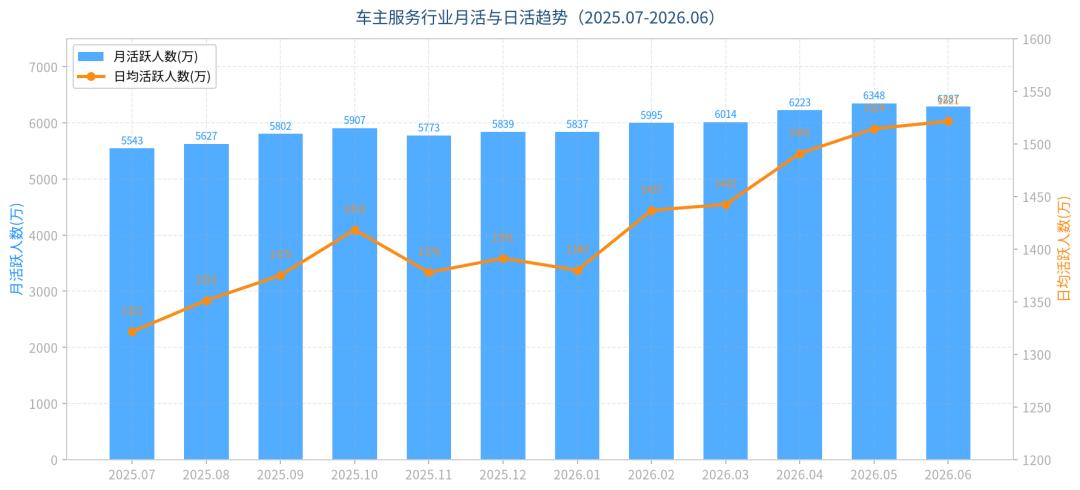
2026年6月,国内车企APP行业月活用户达6287万,同比增长12.5%,日均活跃人数为1521万,同比增长14.9%1。其中,比亚迪以1176万的月活用户数遥遥领先,较第二名上汽大众(609万)接近翻倍,自身同比增幅达47.7%1。
在用户黏性方面,新势力应用引力域以9.1分钟的人均单日使用时长登顶,远超行业均值4.1分钟1。与此同时,行业整体用户行为呈现活跃特征,人均单日启动次数为3.4次1。新能源汽车渗透率已达62.8%1。
市场呈现明显的结构性分化。传统合资品牌普遍面临压力,东风日产、梅赛德斯-奔驰、iBuick分别同比下滑11.8%、13.8%、15.7%1;而新势力企业保持强劲增长势头,长城汽车、小鹏汽车、吉利银河的月活同比增幅分别为138.9%、166.3%、99.4%1。新势力APP整体呈现正增长且用户黏性普遍高于传统车企1。尽管各企业在规模和黏性上表现差异明显,但目前尚未出现兼具超高月活和超高黏性的"超级APP"1。
近期,部分车企在智能驾驶和大模型领域推进动作频繁。小鹏汽车于6月29日发布X-Mind车载技术框架1,理想汽车于6月15日发布自研基座大模型马赫Mind-Pro与Mind-Edge1,蔚来5月智能辅助驾驶总使用里程接近2亿公里1。
China's automotive app sector reached 62.87 million monthly active users in June 2026, representing a 12.5% year-over-year increase, with daily active users climbing 14.9% to 15.21 million 1. BYD emerged as the clear market leader with 11.76 million monthly active users, nearly doubling the second-place SAIC Volkswagen at 6.09 million and achieving a 47.7% year-over-year surge 1.
The industry exhibits a pronounced structural divide between scale and user engagement. Leili's app commanded the highest stickiness metric with an average daily usage time of 9.1 minutes per user, substantially exceeding the sector average of 4.1 minutes 1. Chinese automakers demonstrated robust momentum, with Great Wall Motor posting 138.9% growth, XPeng Motors surging 166.3%, and Geely Galaxy advancing 99.4% year-over-year 1. Conversely, traditional joint-venture brands faced significant headwinds, including Dongfeng Nissan declining 11.8%, Mercedes-Benz slipping 13.8%, and iBuick dropping 15.7% 1.
The sector has not yet produced a "super app" combining both exceptional monthly active user volumes and superior user stickiness, indicating that the industry remains fragmented between scale-focused and engagement-focused players 1. New energy vehicles account for 62.8% of the market, with users launching automotive apps an average of 3.4 times daily and spending an average of 4.1 minutes per day on these platforms 1.
评论
还没有评论,欢迎留下第一条。