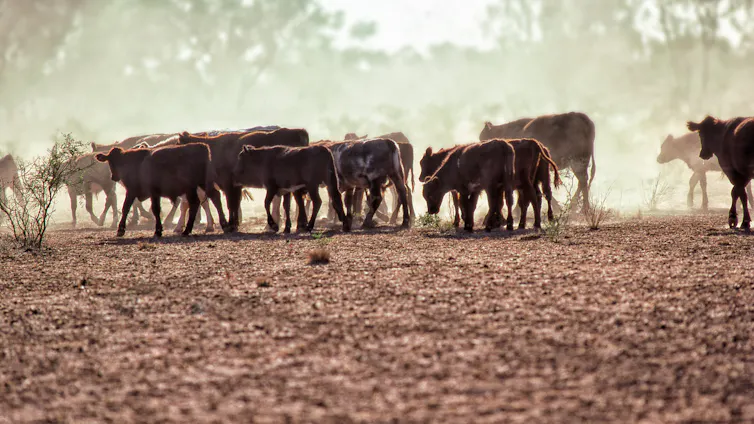
一项新研究显示,气候变化正导致澳大利亚北部危险高温天数显著增加,严重威胁当地约3080万头牛中近一半在热带及半干旱地区户外放牧的畜群 1。数据显示,澳大利亚整体气温比1910年升高约1.5°C 1。2024年的数据表明,澳大利亚平均每人每年食用约22公斤牛肉 1。研究使用热负荷指数(Heat Load Index)评估不同品种牛的耐热能力,指出英国品种的牛在指数达到86时出现危险,而婆罗门等热带品种可耐受至96 1。
在不同排放情景下,各类牛群面临的极端天气压力将持续攀升。对于英国品种牛,目前经历危险高温的天数为117天;在低排放情景下,到2050年代该数字将增至143天;而在高排放情景下,到2090年代将激增至195天 1。相比之下,耐热的婆罗门品种目前仅有17天处于危险高温期,但在低排放情景下到2050年代这一天数将升至32天,并在2090年代高排放情景下达到84天 1。具体到地理区域,在昆士兰州达比地区,高排放情景下到2090年代危险天数将从目前的45天升至134天 1。在北领地巴克利地区,高排放情景下到2090年代危险天数则将从目前的15天增至106天 1。
高温不仅直接威胁牲畜健康,还迫使养殖户改变经营策略并影响劳工安全。当气温达到38°C时,奶牛进食量减少15–18%,进而导致增重缓慢和肉质下降 1。为了缓解热应激,有效遮阴设施需阻挡70%的阳光,这促使养殖户建设遮阴设施或调整养殖品种 1。此外,牧场工人的劳动风险也在增加。以北领地巴克利地区为例,在高排放情景下,白天赶牛对工人来说不安全的天数预计将从目前的134天增加到217天 1。
A new study indicates that climate change is significantly increasing the number of days with dangerous heat levels in northern Australia, posing a severe risk to approximately 30.8 million cattle grazed outdoors 1. Roughly half of the nation's total cattle population is located in the tropical and semi-arid regions of the north, where rising temperatures are becoming a critical concern for livestock health 1. The country's overall average temperature has already increased by about 1.5°C since 1910, intensifying environmental pressure on these herds 1.
Researchers utilized the Heat Load Index (HLI) to assess thermal stress, finding that British breed cattle face dangerous conditions when the index reaches 86, whereas Brahman breeds can tolerate up to an HLI of 96 1. Under current conditions, British breeds experience 117 days of dangerous heat annually; this figure is projected to rise to 143 days by the 2050s under low-emission scenarios and surge to 195 days by the 2090s under high-emission scenarios 1. Similarly, dangerous heat days for Brahman breeds are expected to increase from 17 days currently to 32 days in the 2050s (low emission) and 84 days in the 2090s (high emission) 1. Regional impacts vary, with Derby in Queensland facing an increase from 45 to 134 dangerous days by the 2090s under high emissions, while Barkly in the Northern Territory will see a jump from 15 to 106 days over the same period 1.
The physiological effects of heat are substantial, with cows reducing feed intake by 15–18% at temperatures of 38°C, which leads to slower weight gain and diminished meat quality 1. To mitigate these risks, farmers must install shade structures that block at least 70% of sunlight or adjust their breeding practices 1. Beyond animal welfare, worker safety is also compromised; in the Barkly region, the number of days unsafe for daytime cattle handling under high-emission scenarios is projected to increase from 134 to 217 days 1. These shifts occur within a context where Australians consume an average of 22 kilograms of beef per person annually, based on 2024 data 1.
评论
还没有评论,欢迎留下第一条。