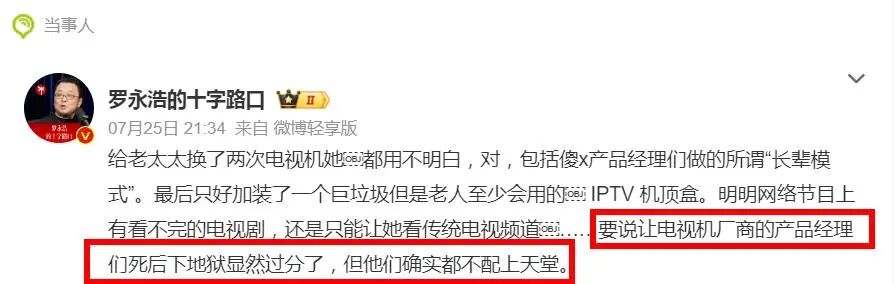
7月25日,罗永浩在微博上对电视机厂商的"长辈模式"设计提出激烈批评1。这一吐槽迅速引发广泛共鸣,相关话题于7月26日冲上热搜第一,吸引60多家媒体跟进报道1。
面对舆论压力,多家电视厂商随后回应了这一争议。海信电视表示,长辈模式仅能优化主页操作,但观看有线电视直播时仍需用户手动切换信号源1。创维电视则补充说明,长辈模式仅在部分型号支持,同样无法改变信号源切换这一核心步骤1。这些回应实质上承认了该功能存在的根本性局限。
行业层面,国家广播电视总局已于2025年8月28日通过广播电视规划院发布了《便捷看电视产品认证方案》1,旨在推动电视使用体验改善。然而截至2026年6月底,获得"便捷看电视"认证的电视机型号仅约8-10款1。由于该认证并非强制性要求,在消费群体中未能形成足够的心智强化1。同期数据显示,2026年上半年中国大陆电视市场品牌整机出货量为1494.7万台,较2025年同期下降10.1%1,反映出电视行业面临的深层次挑战。
Luo Yonghou sparked widespread controversy on July 25 when he sharply criticized television manufacturers over the impractical design of their "elder mode" features 1. The criticism rapidly gained traction, with the related topic ranking first on trending searches by July 26, prompting coverage from over 60 media outlets 1.
Following the uproar, major TV manufacturers issued clarifications about their elder mode capabilities. Hisense stated that its elder mode only optimizes homepage navigation but cannot alter the core process of manually switching signal sources to watch cable television broadcasts 1. Similarly, Skyworth explained that the elder mode feature is available only on select models and remains unable to change the fundamental signal source switching procedure 1.
The controversy exposed deeper structural challenges within the television industry, which suffers from complicated operation procedures and excessive advertising 1. In response to these systemic issues, China's State Administration of Radio, Television, and Cinema released a "Convenient TV Viewing Product Certification Scheme" on August 28, 2025 1. However, the initiative has struggled to gain traction. As of June 30, 2026, only approximately 8 to 10 TV models had obtained the "Convenient TV Viewing" certification 1. Since the certification is voluntary rather than mandatory, it has failed to establish sufficient market awareness and consumer preference 1.
评论
还没有评论,欢迎留下第一条。