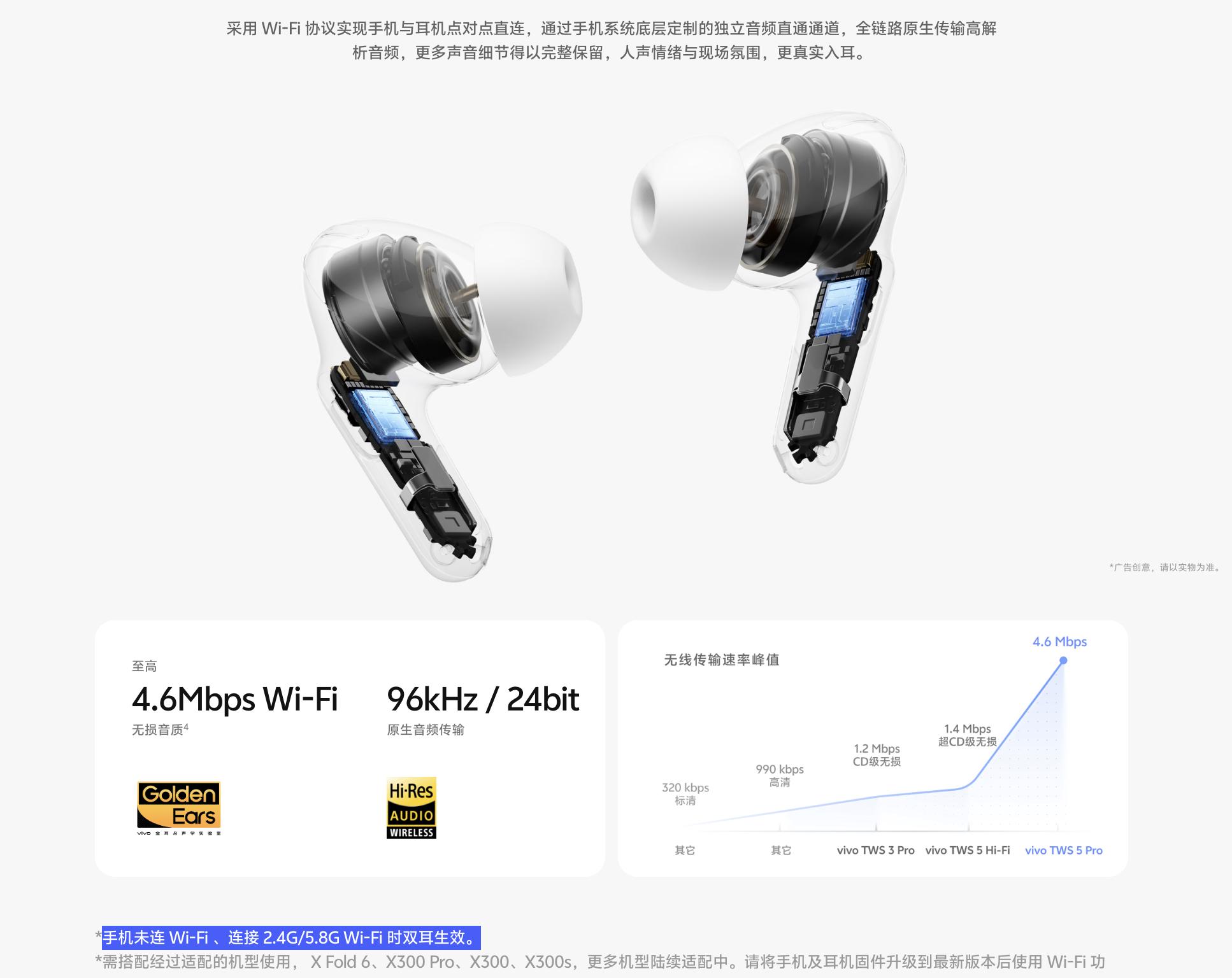
vivo近期发布了支持Wi-Fi无损音频传输的旗舰真无线耳机TWS 5 Pro,该产品最高支持4.6Mbps的传输速率1,超越小米Buds 5 Pro Wi-Fi版的4.2Mbps1。然而,业界对微功耗Wi-Fi在可穿戴设备上的实现路径出现了分化。vivo采取私有方案,通过手机与耳机点对点直连的方式实现Wi-Fi传输1;而高通XPAN技术则让耳机直接连接Wi-Fi接入点,支持用户在超出蓝牙覆盖范围的地方继续使用1。
高通XPAN支持24bit/192kHz的无损音频标准1,在传输24bit/96kHz无损音频时的功耗水平与96kHz有损蓝牙相当1。小米Buds 5 Pro Wi-Fi版单耳机续航可达10小时1,证明了微功耗Wi-Fi连接的可行性。高通CEO安蒙在1月CES上阐述了这一技术愿景:在蓝牙功耗级别下运行Wi-Fi,使用户即使远离手机也能获取独立IP地址,直接与智能体连接1。高通在6月COMPUTEX 2026宣布其技术将覆盖低于2mW级别的耳机平台1,预示这一微功耗方案有望在个人AI终端中广泛应用。
Vivo has introduced the TWS 5 Pro, flagship true wireless earbuds featuring Wi-Fi lossless audio transmission with a maximum transfer rate of 4.6 Mbps 1. This marks a competitive step in the emerging category of Wi-Fi-connected wearables, surpassing Xiaomi's Buds 5 Pro Wi-Fi edition, which supports 4.2 Mbps 1.
The two manufacturers employ notably different technical approaches. Vivo uses a proprietary solution enabling point-to-point direct connection between the phone and earbuds 1. In contrast, Qualcomm's XPAN ultralow-power Wi-Fi technology allows earbuds to connect to Wi-Fi access points, permitting continued use beyond Bluetooth range 1. Qualcomm's XPAN supports 24-bit/192kHz lossless audio, with 24-bit/96kHz lossless transmission consuming power equivalent to standard Bluetooth at 96kHz 1. Xiaomi's Buds 5 Pro Wi-Fi edition achieves up to 10 hours of single-earbud battery life, demonstrating the practical viability of ultralow-power Wi-Fi connectivity 1.
Qualcomm CEO Amon noted at CES in January that Wi-Fi operating at Bluetooth power levels allows users to obtain IP addresses and communicate with intelligent agents without relying on their phones 1. Qualcomm announced at Computex 2026 in June that its technology extends to earbud platforms consuming below 2mW 1. This technological advancement could enable wearable devices to connect directly to cloud-based AI services without smartphone intermediation.
评论
还没有评论,欢迎留下第一条。