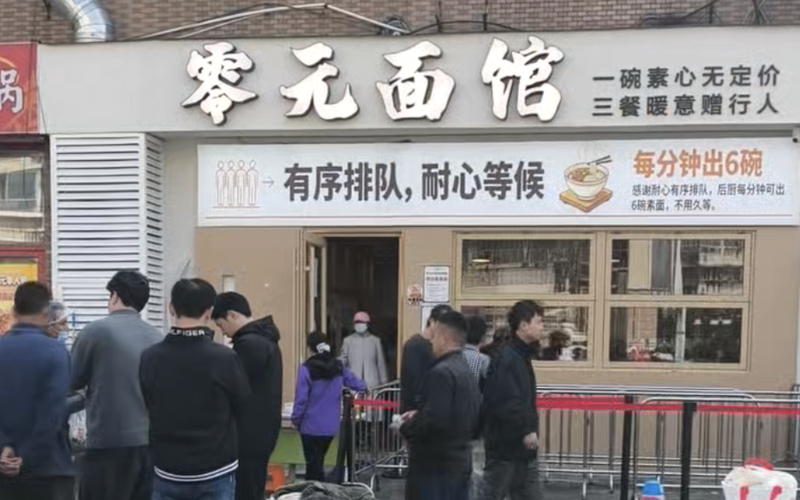
南京目前已有两家“零元面馆”,分别位于江宁区秣陵街道殷巷片区和雨花台区岱山片区 1。江宁店于10月8日开业,附近一家安徽板面店老板称日营业额下降两三百元左右 1。一家距离更近的面馆表示,零元面馆开业七八天后,店内日营业额下降约2000元 1。虽然其经营合规且受到部分好评,但导致周边同类低价面食商户客流减少、营业额下降,甚至面临退租 1。
南京市雨花台区市场监管局西善桥分局确认面馆证照齐全,属合规经营 1。辽宁开世律师事务所合伙人许晟博律师指出,“零元面馆”不属于《中华人民共和国反不正当竞争法(2025年修订)》中所列举的不正当竞争行为 1。清华大学公共管理学院教授邓国胜认为,“零元面馆”是一种不被《慈善法》认可的非典型慈善行为 1。因无差别开放可能导致资源错配,该行为可能造成稀缺慈善资源的浪费并冲击正常市场秩序 1。
Two "zero-yuan noodle shops" currently operating in Nanjing have drawn significant attention for their unconditional free meals, a model that is causing tangible financial harm to nearby low-cost dining establishments 1. The first shop opened on October 8 in the Yinxiang area of Moling Street, Jiangning District, while a second location operates in the Daishan area of Yuhuatai District 1. Although the concept has received some praise, local competitors report steep declines in revenue since the shops began operations 1. One noodle restaurant owner located closer to the new venture stated that daily turnover dropped by approximately 2,000 yuan after the zero-yuan shop had been open for seven to eight days, while the owner of a nearby Anhui-style board noodle shop reported losing between 200 and 300 yuan per day 1. Some affected merchants are now facing difficulties maintaining their leases due to reduced customer flow 1.
Regulatory authorities have confirmed that the zero-yuan shops operate within legal boundaries. The Xishanqiao Branch of the Nanjing Yuhuatai District Market Supervision Bureau verified that the establishments possess complete licenses and permits, classifying their operations as compliant 1. Legal experts note that this business model does not constitute unfair competition under the Anti-Unfair Competition Law of the People's Republic of China (2025 Revision), according to Xu Shengbo, a partner at Liaoning Kaitai Law Firm 1. However, scholars argue that the approach represents a non-typical form of charity that fails to align with established legal frameworks. Deng Guosheng, a professor at Tsinghua University’s School of Public Policy and Management, explained that because these shops do not recognize specific charitable statuses under the Charity Law, they lack precise targeting mechanisms for vulnerable groups 1. He warned that such indiscriminate distribution risks wasting scarce charitable resources and disrupting normal market order, suggesting that charity should be managed more strategically to create greater social value 1.
评论
还没有评论,欢迎留下第一条。