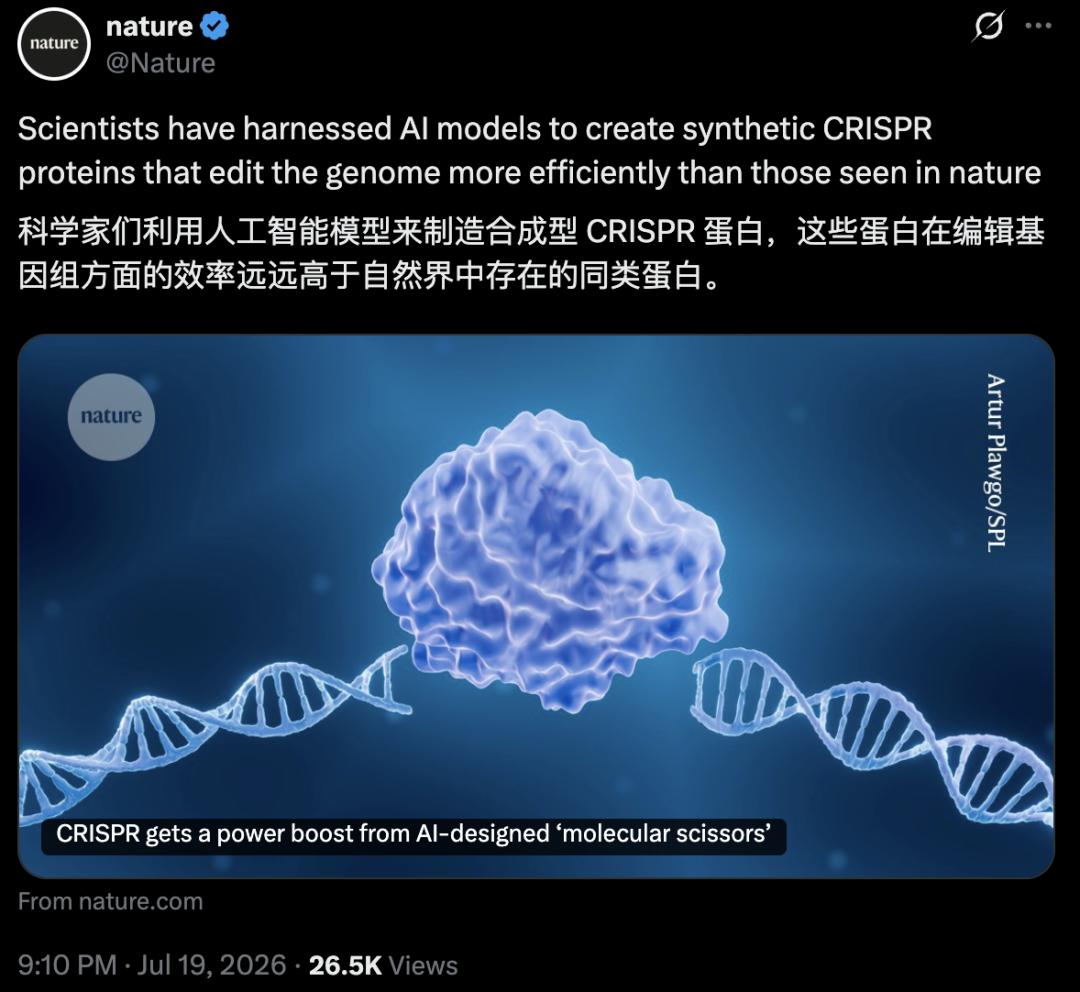
科学家利用人工智能技术成功设计出自然界不存在的新型CRISPR酶,性能指标均超越经过数十亿年进化的天然酶。2020年诺贝尔化学奖得主Jennifer Doudna团队改造TnpB酶,修改了约30%的序列后仍保持完整功能;创业公司Profluent生成的OpenCRISPR-1在靶向编辑效率和脱靶率上均取得突破。相关研究成果于7月16日刊登在《Nature》和《Science》上1。
OpenCRISPR-1的靶向编辑效率达到55.7%,超越天然Cas9的48.3%;脱靶编辑率仅为0.32%,相比Cas9的6.1%降低了约95%1。这两款人工设计的CRISPR蛋白与天然版本存在显著差异:OpenCRISPR-1与SpCas9之间有403个突变差异,与任何天然CRISPR蛋白至少相差182个突变1。考虑到Cas9蛋白通常超过1000个氨基酸,理论上的可能序列组合数高达20的1000次方1,这一成就体现了AI在蛋白质设计中的巨大潜力。
此前同类AI工作对酶序列的改动幅度仅在1%到2%之间,而Doudna团队的30%改动幅度标志着该领域的重大突破1。Doudna本人表示:"我们需要AI工具帮我们跑得更快,但要把这类模型的价值榨到最大,仍然需要真正懂分子机制的人"1。这项研究表明科学界正从发现和应用自然基因工具向利用AI创造全新基因工具转变。
Scientists have successfully designed a new type of CRISPR enzyme that does not exist in nature by leveraging artificial intelligence technology.1 Research published simultaneously in Nature and Science on July 16 demonstrates that AI-generated gene-editing tools can outperform their naturally evolved counterparts.1
Jennifer Doudna's team, the 2020 Nobel Prize in Chemistry recipient, redesigned the TnpB enzyme by modifying approximately 30% of its sequence while maintaining its functionality—a substantially larger modification rate compared to previous AI-driven efforts that typically altered only 1% to 2% of sequences.1 In parallel, startup Profluent developed OpenCRISPR-1, an AI-designed enzyme that demonstrated superior performance across key metrics: it achieved a 55.7% on-target editing efficiency compared to the natural Cas9's 48.3%, and reduced off-target editing rates to 0.32% from Cas9's 6.1%—a 95% reduction.1 The OpenCRISPR-1 protein differs from the natural Cas9 by 403 mutations and diverges from any known natural CRISPR protein by at least 182 mutations.1
The achievement marks a pivotal transition from discovering existing gene-editing tools in nature to creating entirely novel molecular instruments through computational design. Doudna emphasized the collaborative nature of this advancement: "We need AI tools to help us move faster, but to maximize the value of these models, we still need people who truly understand molecular mechanisms."1 Given that a single Cas9 protein typically exceeds 1,000 amino acids with possible sequence combinations numbering 20 to the power of 1,000, the AI-driven approach dramatically accelerates the exploration of this vast molecular design space.1
评论
还没有评论,欢迎留下第一条。