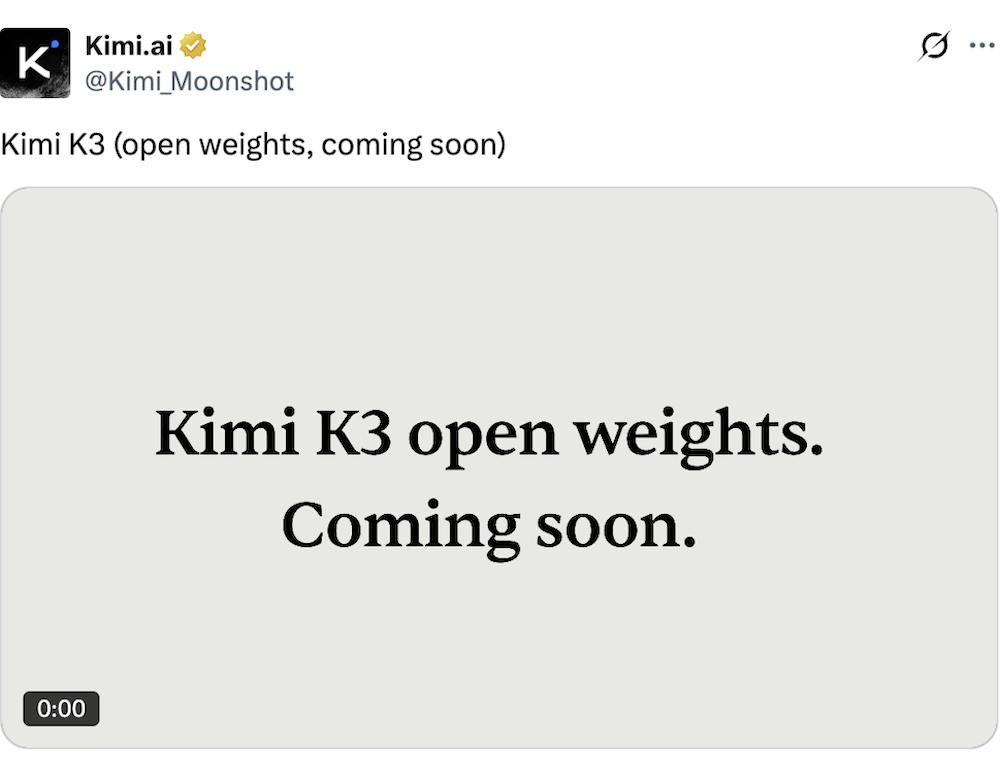
月之暗面发布并开源了Kimi K3大模型1。该模型拥有2.8万亿参数,采用混合专家(MoE)架构,支持100万token的上下文窗口,并具备原生视觉理解能力1。同时,月之暗面还开源了MoonEP、FlashKDA和AgentEnv三项关键基础设施技术1。其中MoonEP是超大细粒度MoE高性能通信库,FlashKDA是高性能算子,能在H20上将prefill速度提升1.72-2.22倍,AgentEnv则是大规模Agent训练沙箱系统1。
Kimi K3在多项评测中表现突出。在编程领域,该模型在SWE Marathon和Program Bench等测试中排名第一,Terminal Bench 2.1达到88.3分,接近GPT-5.6 Sol的水平,在FrontierSWE中得分81.2分仅次于Claude Fable 51。在Agent任务方面,BrowseComp达91.2分,Automation Bench和SpreadsheetBench 2排名第一1。在视觉理解测试中,OmniDocBench达到91.1分1。发布30分钟内,该模型在Hugging Face趋势榜获得超4000赞,创造了迄今最快的发布增长速度1。
模型发布后获得了广泛的生态支持。Cognition、Nebius、Baseten、Fireworks等海外AI基础设施厂商宣布了Day 0适配Kimi K31,华为昇腾CANN也对模型MXFP4量化实现Day0原生支持1,趋境科技完成了Kimi K3在华为昇腾910C超节点的Day0适配1。开发者测试数据显示,Kimi K3在游戏设计任务中表现最优,调用成本为0.030美元,相比Claude Fable 5的0.38美元和GPT-5.6 Sol的0.11美元更具成本优势1。
Moonshot AI has released and open-sourced Kimi K3, a large language model featuring 2.8 trillion parameters built on a mixture-of-experts (MoE) architecture with native support for a 1 million token context window 1. Alongside the model, the company simultaneously open-sourced three foundational infrastructure technologies: MoonEP, a high-performance communication library for large-scale MoE systems; FlashKDA, a high-performance operator that achieves 1.72 to 2.22 times faster prefill speeds on Huawei Ascend H20 processors; and AgentEnv, a large-scale agent training sandbox system 1.
The release garnered immediate global recognition. Hugging Face CEO Clem Delangue reported that Kimi K3 reached over 4,000 upvotes on the platform's trending leaderboard within 30 minutes, marking the fastest adoption rate to date 1. The model demonstrated strong performance across multiple benchmarks: it ranked first in coding tests including SWE Marathon and Program Bench, achieved a score of 88.3 on Terminal Bench 2.1 approaching GPT-5.6 Sol's level, and scored 81.2 on FrontierSWE, second only to Claude Fable 5 1. On the BrowseComp benchmark, Kimi K3 scored 91.2, with top placements on Automation Bench and SpreadsheetBench 2, while reaching 91.1 on the OmniDocBench vision task 1.
The model has secured rapid integration support from major infrastructure providers. International companies including Cognition, Nebius, Baseten, and Fireworks announced Day 0 compatibility with Kimi K3 1. Within China, Huawei's Ascend CANN platform provided native Day 0 support for MXFP4 quantization of the model, and Jingfin Technology completed Day 0 adaptation of Kimi K3 on Huawei Ascend 910C supercomputers 1. Developer testing revealed significant cost advantages, with Kimi K3 delivering optimal performance in game design tasks at a calling cost of $0.030, substantially lower than Fable 5's $0.38 or GPT-5.6 Sol's $0.11 1.
评论
还没有评论,欢迎留下第一条。