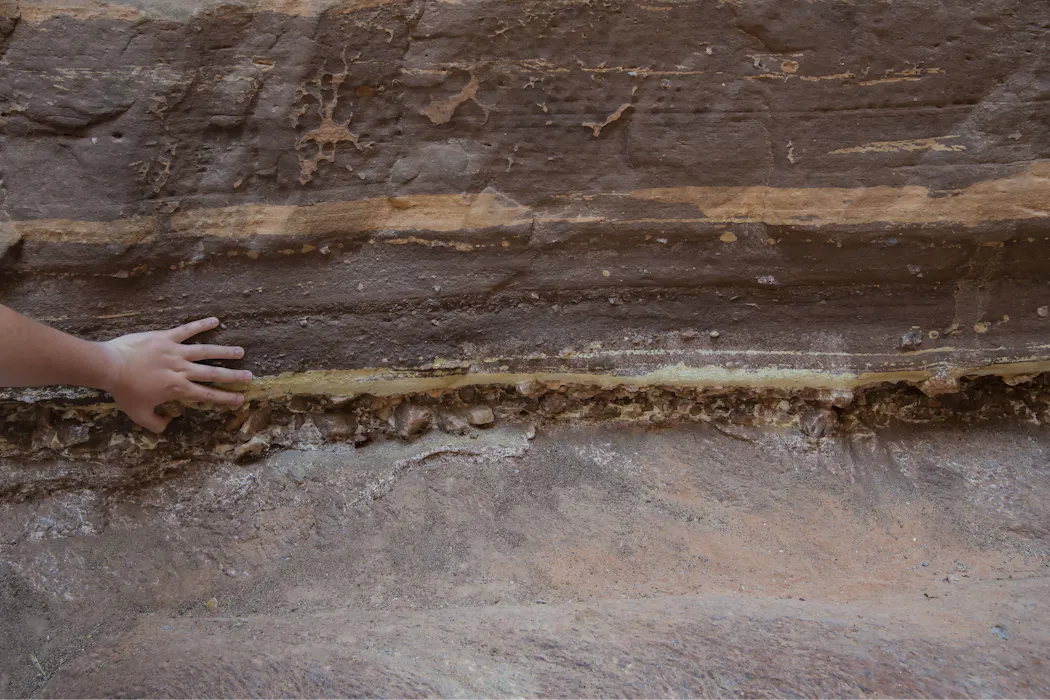
一项发表于《自然》杂志的新研究旨在解释地质学界长期关注的谜团——地球岩石记录中被称为“大不整合面”(The Great Unconformity)的缺失层成因 1。该现象最早于1870年代被发现,表现为数亿年甚至长达十亿年的岩层缺失 1。例如在美国大峡谷,5.4亿年前的沉积岩直接覆盖在20亿年前的结晶基底之上,中间漫长的地质历史仿佛凭空消失 1。
研究指出,这一巨大时间空缺主要由地幔对流驱动的大陆垂直运动配合极端气候下的剧烈侵蚀所造成 1。约10亿年前至5.4亿年前期间,包括劳伦古陆、波罗的古陆和华北克拉通在内的古代大陆块因地幔对流作用被抬升 1。恰逢“雪球地球”时期(7.2亿至6.35亿年前),巨大的冰盖对暴露在地表的大陆进行了高效且剧烈的侵蚀,从而移除了中间的地层 1。随后这些大陆块再次下沉,形成了现今观察到的不整合面结构 1。
利用澳大利亚超级计算机Gadi进行的建模结果显示,这一过程主要影响了北美、北欧和东亚的部分区域 1。相比之下,澳大利亚和南美洲受影响较小,因此缺乏明显的不整合面证据 1。研究人员认为,“大不整合面”的形成时间与约5.4亿年前的寒武纪生命大爆发高度吻合 1。大陆侵蚀可能改变了海水的化学平衡,进而为复杂动物生命的繁荣创造了关键的环境条件 1。
A study published in Nature has identified the mechanism behind the Great Unconformity, a significant gap in the geological record where layers spanning up to one billion years are missing 1. First noted in the 1870s, this phenomenon is exemplified by sites like the Grand Canyon, where sedimentary rocks dated to 540 million years ago rest directly atop crystalline basement rocks formed 2 billion years earlier 1. Researchers Santosh Dhungana and Nicolas Flament from the University of Wollongong propose that vertical movements driven by mantle convection, combined with intense glacial erosion, removed these intermediate strata 1.
The core of the finding involves the uplift of ancient continental blocks, including Laurentia, Baltica, and the North China Craton, between approximately 1 billion and 540 million years ago 1. This period coincided with the "Snowball Earth" glaciation events (720–635 million years ago), during which massive ice sheets efficiently eroded the exposed land surfaces and stripped away the overlying sedimentary layers 1. When these continents later subsided, they remained largely protected from such severe erosive forces 1.
Modeling conducted on Australia’s supercomputer Gadi indicates that this process primarily affected regions in North America, Northern Europe, and East Asia 1. In contrast, areas like Australia and South America show less evidence of such unconformities due to minimal impact from these vertical movements 1. The timing of this geological event aligns closely with the Cambrian explosion around 540 million years ago, suggesting that the widespread erosion may have altered seawater chemistry in ways that facilitated the rapid diversification of animal life 1.
评论
还没有评论,欢迎留下第一条。