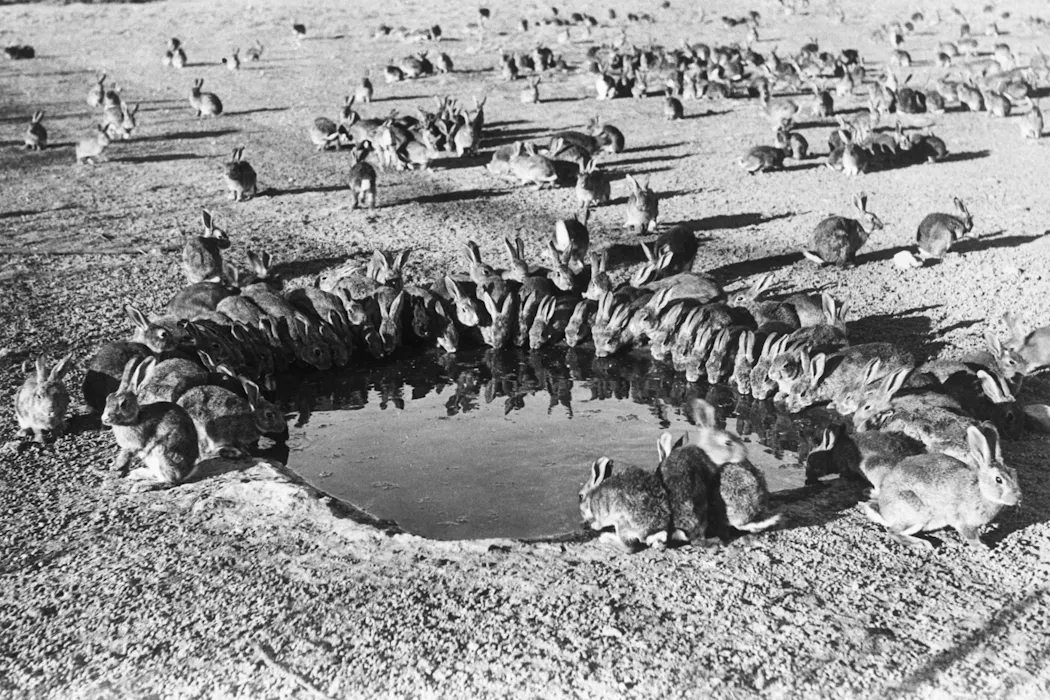
1859年圣诞节,英国移民托马斯·奥斯汀在澳大利亚释放了约两打兔子1,这一决定引发了澳大利亚历史上最严重的生物入侵事件之一。兔子具有极强的繁殖能力,单只母兔每年可生育多达50只幼兔1。到1920年,澳大利亚的兔群数量已估计达到100亿1,对农业和本土生态系统造成了灾难性的破坏。兔群威胁超过300种本土动物和植物1。
澳大利亚长期采用病毒生物防治策略来控制兔群。1950年代,澳大利亚科学和工业研究组织(CSIRO)发布了粘液病毒,在某些地区使兔群数量下降了95%1。1995年之后,科学家开始测试兔出血病病毒1。然而,最近报告显示兔群数量急剧上升1。2017年,当局发布了新型病毒株K51。现有估计兔群数量约2亿1。
针对这一持续的威胁,CSIRO正在开发包括基因驱动在内的长期基因生物防治解决方案1,以期实现对兔群更加有效和可持续的控制。
In 1859, English settler Thomas Austin released approximately two dozen rabbits into Australia, a decision that would trigger one of the country's most severe biological invasions 1. The rabbits, which faced few natural predators in their new environment, proliferated with extraordinary speed; by 1920, the population had ballooned to an estimated 10 billion individuals 1. A single female rabbit can produce up to 50 offspring annually, enabling this explosive growth 1.
The ecological and agricultural consequences have been catastrophic. The expanding rabbit population now threatens more than 300 native animal and plant species 1, while simultaneously devastating farming operations across the continent. Current estimates place the rabbit population at approximately 200 million 1, reflecting a dramatic resurgence in recent years 1.
Australia has deployed viral biocontrol measures to combat the crisis. In the 1950s, the Commonwealth Scientific and Industrial Research Organisation (CSIRO) introduced myxoma virus, which reduced rabbit numbers by as much as 95 percent in some regions 1. Scientists began testing rabbit hemorrhagic disease virus in 1995, and authorities released a new viral strain called K5 in 2017 1. However, these temporary successes have given way to renewed population growth. CSIRO is now pursuing longer-term solutions, including gene-drive technology and other genetic biocontrol approaches, to address the ongoing threat 1.
评论
还没有评论,欢迎留下第一条。