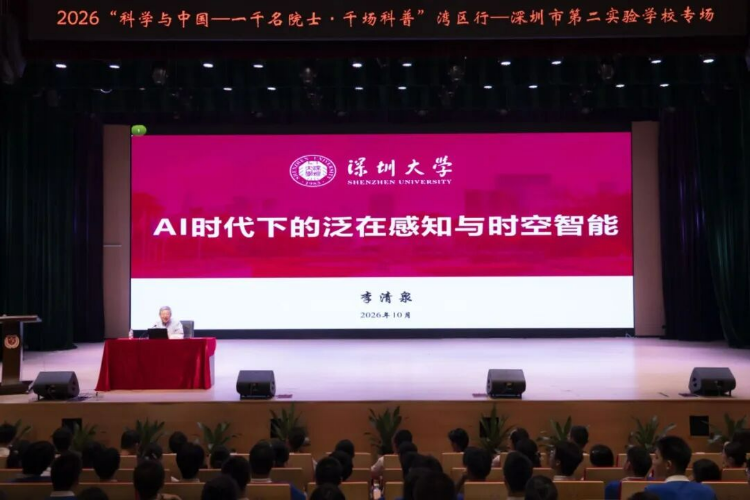
10月13日下午,中国工程院院士、深圳大学教授李清泉在深圳市第二实验学校为高一学生举办了题为《AI时代下的泛在感知与时空智能》的科普讲座1。李清泉现任教育部测绘科学与技术学科评议组成员、中国测绘学会副理事长1。
讲座中,李清泉阐述了时空信息与人工智能融合的前沿方向,介绍了世界模型、城市通用大模型等关键技术1。他展示了深圳大学团队研发的无人机、机器狗等前沿成果1。李清泉强调了人工智能应用中的伦理问题,指出隐私保护、数据安全等挑战需要重视1。在阐述人机协作时,李清泉表示:"机器负责感知与计算,人负责定义问题、作出选择。"1
据悉,"科学与中国"行动已在全国举办超8000场科普活动,千余名院士参与其中1。
On October 13, Chinese Academy of Engineering member and Shenzhen University professor Li Qingquan delivered a public science lecture at Shenzhen Second Experimental School, addressing first-year high school students on the topic "Ubiquitous Perception and Spatiotemporal Intelligence in the AI Era."1 Li explored the convergence of spatiotemporal information and artificial intelligence as a cutting-edge research direction, presenting key technologies including world models and universal urban large models.1 The lecture also featured demonstrations of frontier achievements from Shenzhen University's research teams, including autonomous drones and robotic dogs.1
Beyond technological innovation, Li emphasized the ethical dimensions of advancing spatiotemporal intelligence, highlighting privacy protection and data security as critical challenges requiring serious attention.1 He articulated his vision for human-machine collaboration, stating that "machines are responsible for perception and computation, while humans are responsible for defining problems and making choices."1 As a member of the Ministry of Education's Surveying and Mapping Science and Technology Discipline Evaluation Group and vice chairman of the China Society of Surveying and Mapping, Li brings extensive expertise to the field.1 The lecture is part of the broader "Science and China" initiative, which has organized over 8,000 science popularization events nationwide with participation from more than a thousand academy members.1
评论
还没有评论,欢迎留下第一条。