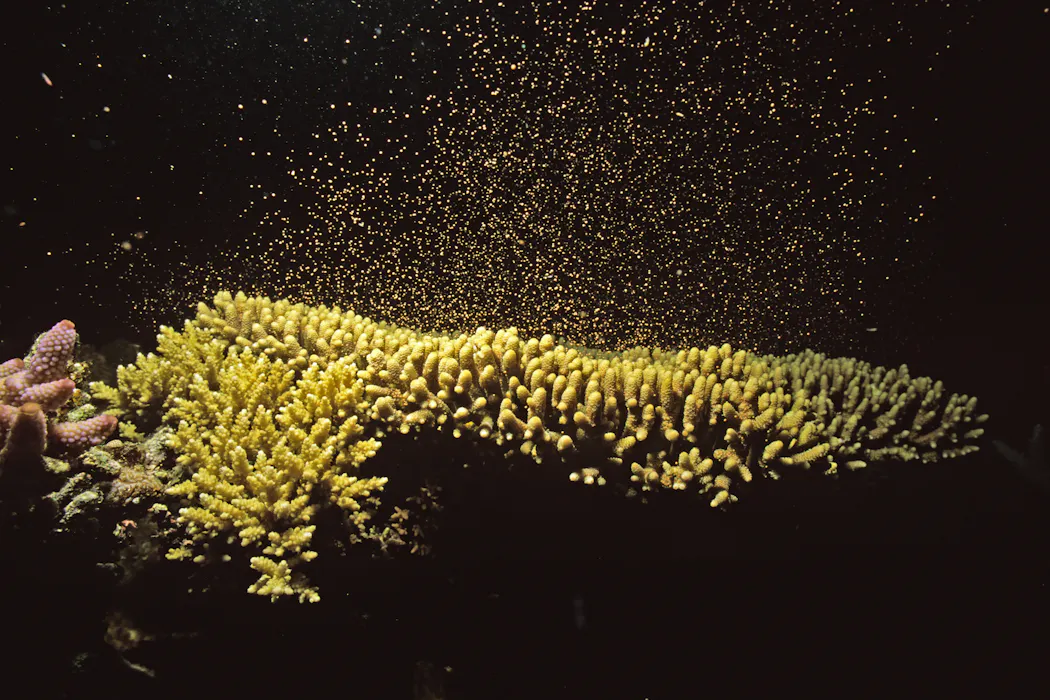
研究人员首次对珊瑚的年度产卵规模进行了系统估算 1。根据这项新研究,印太地区的珊瑚在单次产卵事件中释放约3.5万亿枚卵 1。这项基础性研究通过多尺度分析——从单个珊瑚虫到整个珊瑚群落再到区域分布——为珊瑚的繁殖潜力建立了量化基准 1。
研究涵盖了190,000平方公里的热带珊瑚礁区域 1。数据显示,枝状珊瑚、Porites和Montipora等物种约占总产卵量的一半 1。研究人员发现某些珊瑚物种每平方厘米的产卵量是同类物种的十倍 1,这表明不同物种间的繁殖能力存在显著差异。该研究已发表在《生态学与进化》期刊 1,为珊瑚礁保护和恢复工作提供了重要的数据支撑。这一发现尤为关键,因为自1950年以来全球珊瑚礁覆盖面积已下降约50% 1。
Researchers have for the first time quantified the annual egg production of corals, revealing that corals across the Indo-Pacific region release approximately 3.5 quintillion eggs during a single spawning event 1. This foundational study employed multi-scale analysis—from individual coral polyps to entire reef communities to regional distribution patterns—to establish a baseline for coral reproductive capacity and provide critical data to support coral reef conservation and restoration efforts 1.
The research examined tropical coral reefs spanning 190,000 square kilometers, finding that branching corals, Porites, and Montipora species account for roughly half of the total egg production 1. Scientists also discovered marked variation among coral species, with some producing eggs at rates ten times higher per square centimeter than related species 1. The findings were published in the journal Ecology and Evolution 1.
The study arrives amid ongoing concerns about coral reef decline: global coral reef coverage has decreased by approximately 50 percent since 1950 1.
评论
还没有评论,欢迎留下第一条。