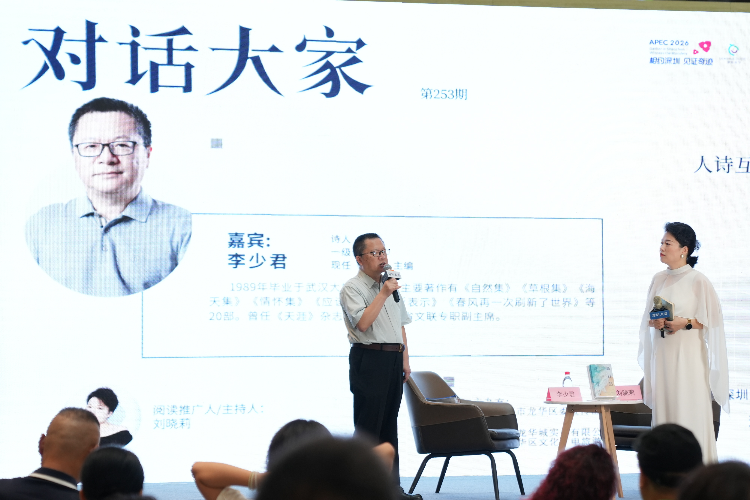
《诗刊》主编李少君近日在深圳举办讲座,阐述了AI时代诗歌创作的核心价值。他认为AI本质上是一种技术主义和修辞游戏,无法复刻真实生命体温1。在此背景下,李少君提出"人诗互证"的诗学观念——即真正的诗歌作品与作者生命彼此印证1——作为诗歌抵御技术异化的精神支点。
李少君以历代诗人为例阐释这一理念。李白《赠汪伦》中"桃花潭水深千尺,不及汪伦送我情"便是生动的人诗互证1。苏东坡则通过黄州、惠州、儋州的贬谪磨砺,完成精神自洽,悟得"此心安处是吾乡"1。在当代,外卖诗人王计兵的作品《赶时间的人》获得一千三百多万阅读量,成为"人诗互证"的实践样本1。李少君强调,普通人书写个人史同样具有时代意义,写作者应守住独属于活人的生命质感1。
他还指出诗教的本意是心灵教育、情感教育,而非死记硬背应付考试1。对于人生中的苦难,李少君表示"伟大往往伴随着磨砺,但是我们不必主动去追逐苦难"1。
Li Shaojun, editor-in-chief of Poetry Journal, delivered two lectures in Shenzhen outlining the core values of poetic creation in the age of artificial intelligence.1 He argued that AI is fundamentally a form of technological determinism and rhetorical manipulation, incapable of replicating the authentic warmth of lived experience.1 According to Li, "human-work mutual verification"—the interplay between a literary work and its author's life—serves as poetry's spiritual bulwark against technological alienation.1
Central to Li's poetic philosophy is the concept that genuine poetry requires works and their creators' lives to authenticate each other.1 He illustrated this principle through classical examples, citing Li Bai's poem to Wang Lun: "The waters of Peach Blossom Pool run a thousand feet deep, yet not as profound as Wang Lun's farewell to me," as a vivid instance of human-work mutual verification.1 Similarly, Su Dongpo's spiritual refinement through exile in Huangzhou, Huizhou, and Danzhoultimately led him to realize "wherever this heart finds peace becomes my home," exemplifying how life's trials strengthen poetic authenticity.1
Li emphasized that contemporary voices embody this principle as well, pointing to delivery courier poet Wang Jibing's work "The Man Racing Against Time," which garnered over thirteen million reads as a modern exemplar of human-work mutual verification.1 He stressed that poetic education should fundamentally be about cultivating the heart and emotions, not rote memorization for examinations.1 Reflecting on the relationship between struggle and greatness, Li noted: "Greatness often accompanies refinement, yet we need not actively pursue suffering."1
评论
还没有评论,欢迎留下第一条。