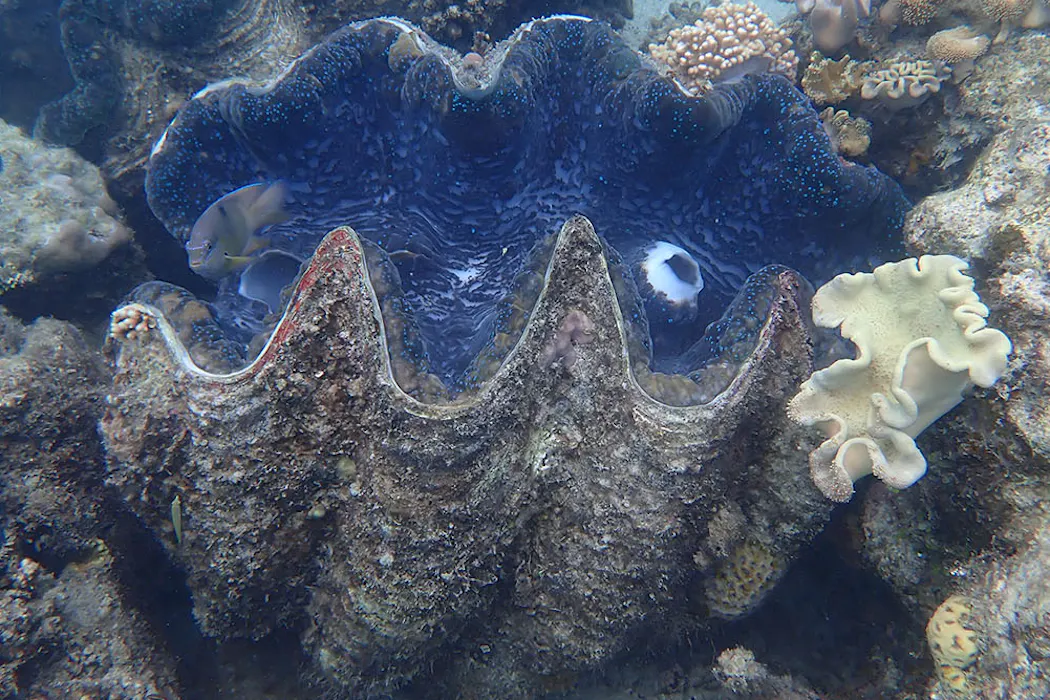
澳大利亚研究人员通过分析采自大堡礁吉古鲁岛泻湖的一枚砗磲壳体,成功重建了该地区两个世纪前的逐月气候条件。1这枚壳体长58厘米,根据放射性碳测年显示该砗磲生活于1785年至1827年间。1壳体内近11000条日生长线记录了约30年的环境变化过程。1
研究人员通过钻取784个微小孔洞采集粉末样品,进而测量壳层中的氧碳同位素比例,以重建古代海洋条件。1分析结果表明,225年前该地区年均海温比1995-2015年低0.6-0.9°C,夏季温度低1.2°C,而冬季温度基本相同。1此外,壳体记录还显示出两到三年周期的厄尔尼诺和拉尼娜样式变异特征。1这项研究发表在《全球与行星变化》期刊,并与瓦尔姆巴尔原住民公司和恩古鲁蒙古原住民公司合作进行。1
Researchers have reconstructed detailed monthly climate conditions from the Great Barrier Reef region dating back two centuries by analyzing a single giant clam shell.1 The specimen, measuring 58 centimeters in length, was collected from the blue lagoon of Gygulu Island and lived between 1785 and 1827, according to radiocarbon dating.1 Within its shell structure lay nearly 11,000 daily growth lines, preserving approximately 30 years of environmental data encoded in the organism's chemistry.1
Scientists extracted powder samples through 784 microscopic bore holes drilled into the shell, then measured oxygen and carbon isotope ratios to decode past climate conditions.1 Their analysis revealed that 225 years ago, the region's average annual sea temperature was 0.6 to 0.9°C cooler than during the 1995-2015 reference period, with summer temperatures running 0.9 to 1.2°C lower, while winter temperatures remained essentially unchanged.1 The shell's geochemical record also captured climatic oscillations consistent with El Niño and La Niña patterns occurring on two- to three-year cycles.1 The research, conducted in collaboration with Walmbarl Indigenous Corporation and Ngurrumungu Indigenous Corporation, was published in Global and Planetary Change.1
评论
还没有评论,欢迎留下第一条。